
Multi-agent systems are everywhere in demos and rare in production. This post explains what they are, when they help, and what they cost, using one idea per picture.
1. Workflow or agent: who chooses the next step?
Both use a language model. The difference is who decides what happens next.
In a workflow, your code decides. Summarise, then extract, then format. It is predictable, cheap and easy to test.
In an agent, the model decides. It plans, picks a tool, reads the result and chooses again until it thinks it is done. It is flexible, costs more and needs guardrails.
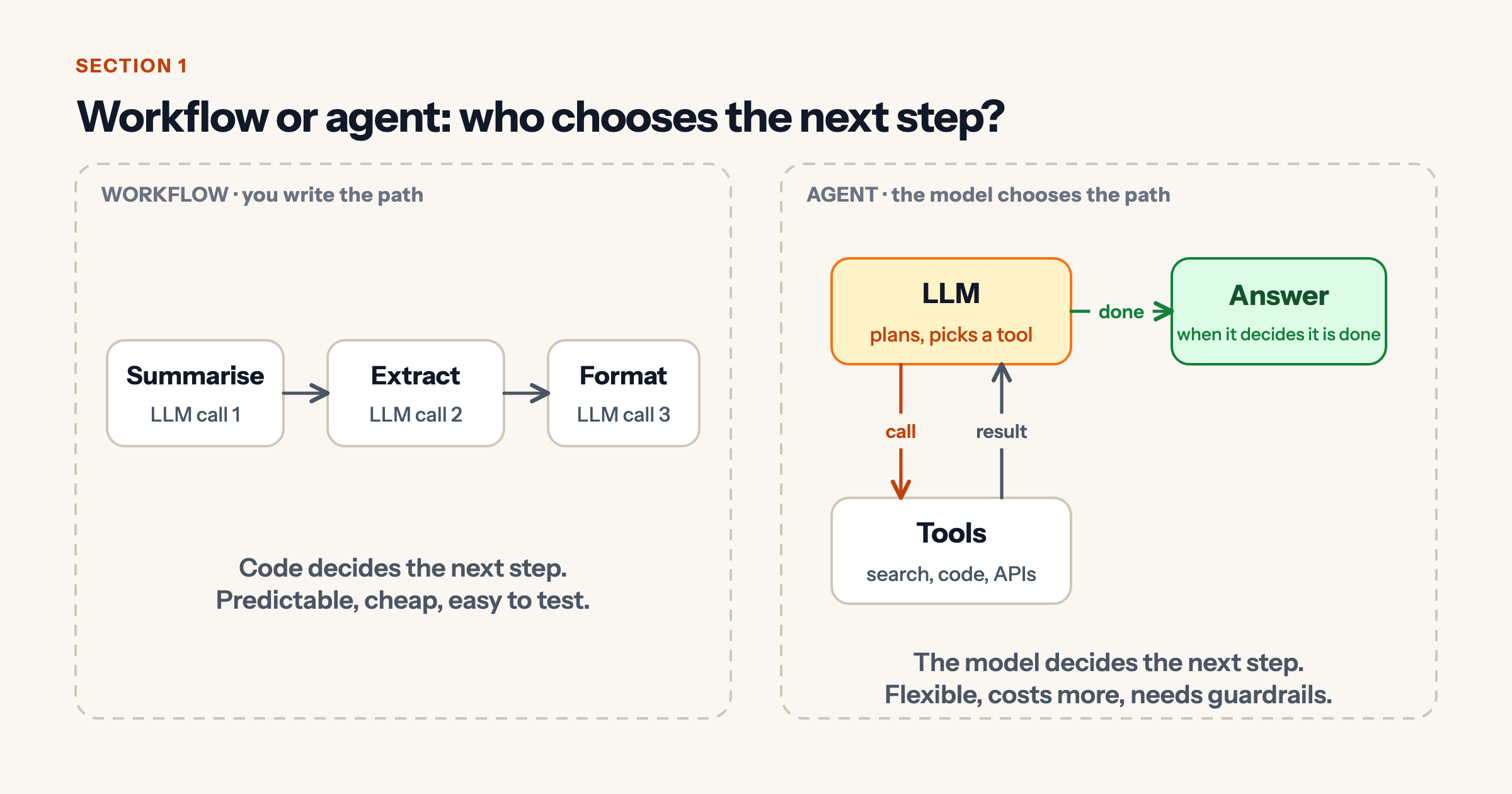
Rule: if you can write the steps down in advance, write a workflow.
2. Five patterns, from simplest to most agentic
Anthropic’s “Building effective agents” guide names five building blocks. Learn them in this order.
- Prompt chaining: each step builds on the last, with optional checks between steps.
- Routing: classify the input, then send it to a specialised prompt.
- Parallelization: split the work or repeat it, then merge the results.
- Orchestrator-workers: a lead model plans on the fly and delegates.
- Evaluator-optimizer: one model drafts, another critiques, repeat.
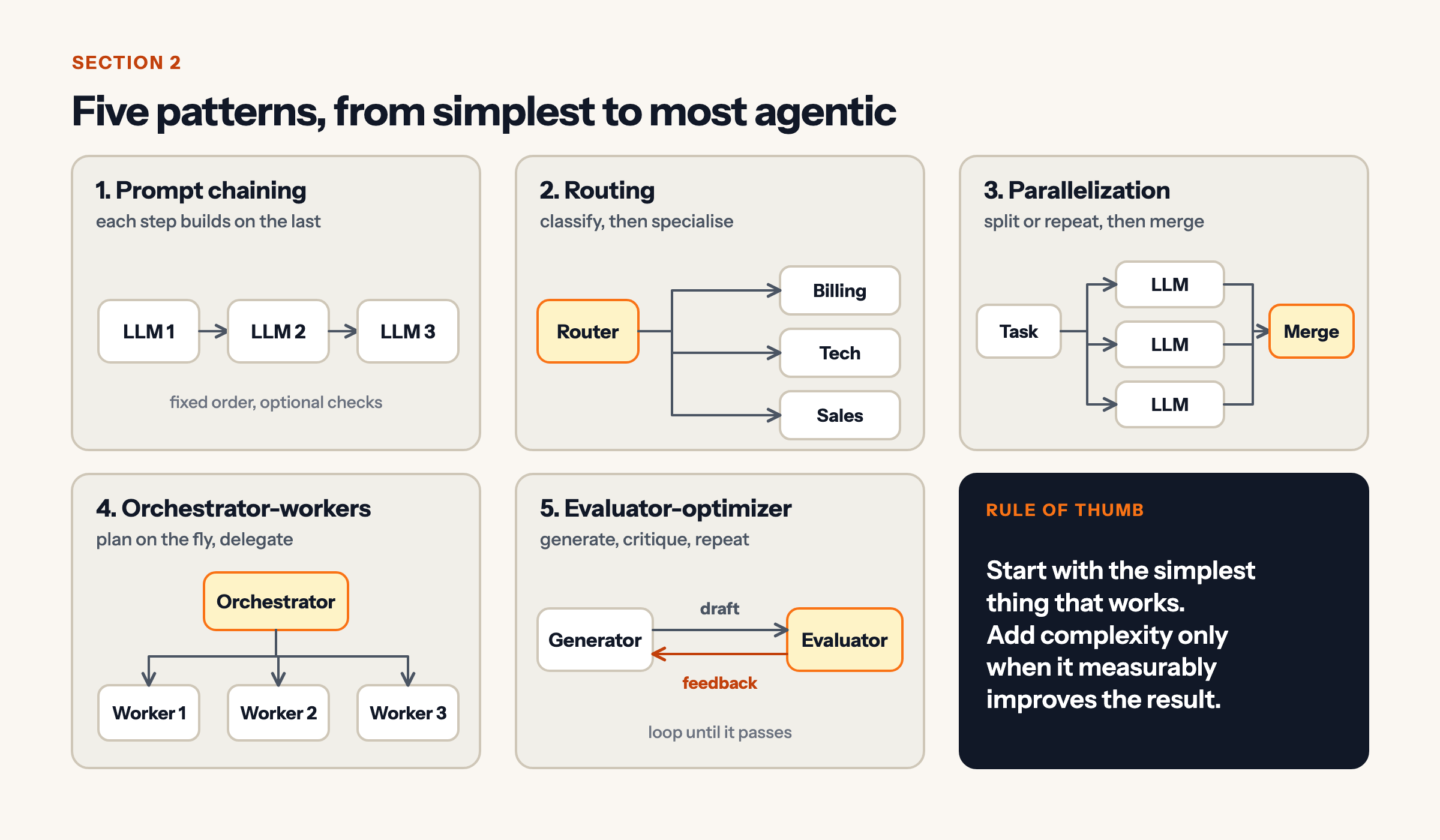
Start with the simplest pattern that works. Add complexity only when it measurably improves results.
3. Orchestrator-workers, step by step
This is what most people mean by “multi-agent”.
A lead agent receives the query, makes a plan and saves it to memory so it survives a long run. It spawns subagents that work in parallel, each with its own context and tools. Each returns condensed findings, not its whole context. The lead merges them, attaches sources and answers.
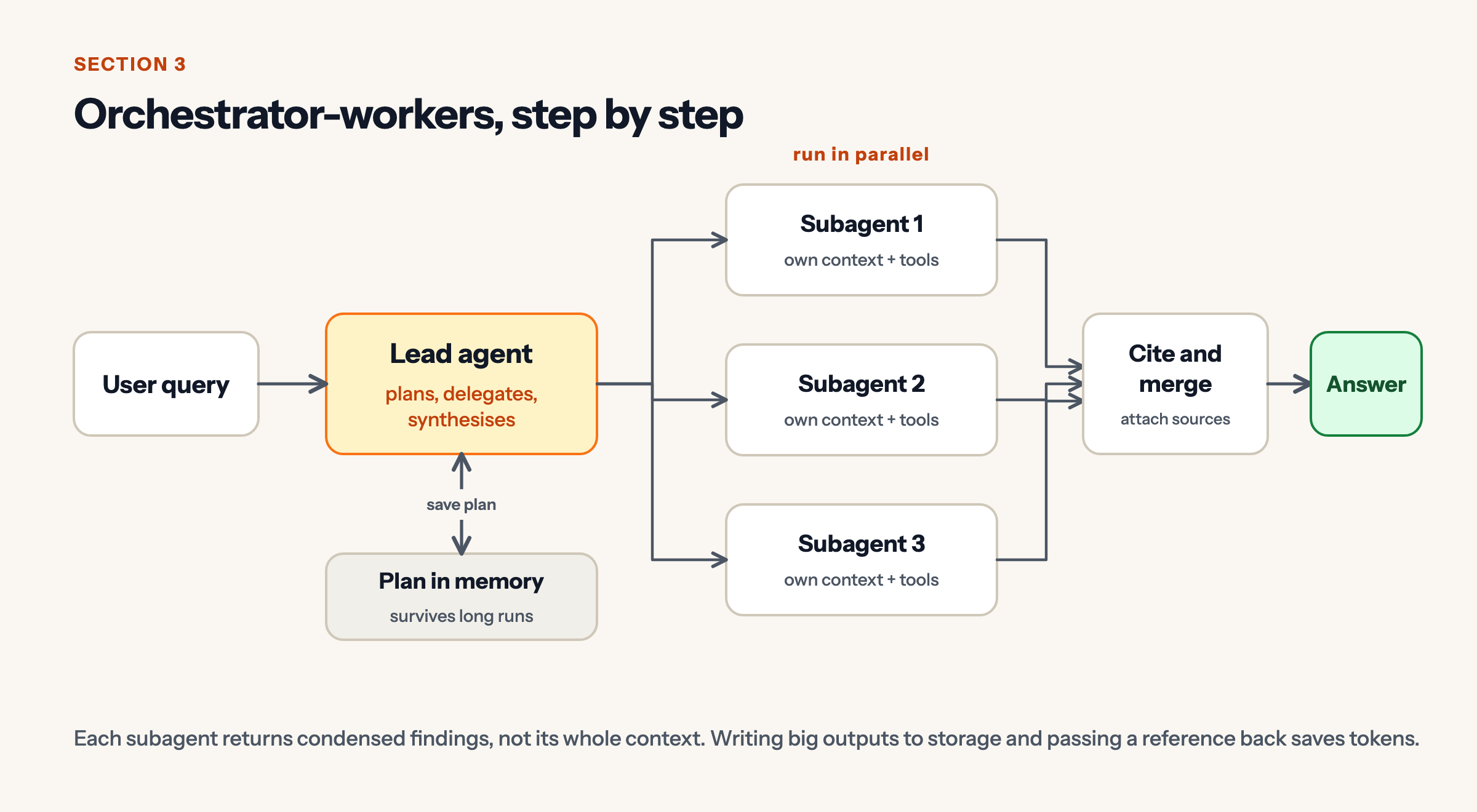
Two practical tips. Give each subagent a precise task, because vague hand-offs cause duplicated work. And let subagents write large outputs to storage and pass back a reference, which saves tokens.
4. The bill
Anthropic reported that, in its own research workloads, agents used about four times the tokens of a chat turn, and multi-agent systems about fifteen times. Your numbers will differ, but the shape holds: more agents means more tokens.
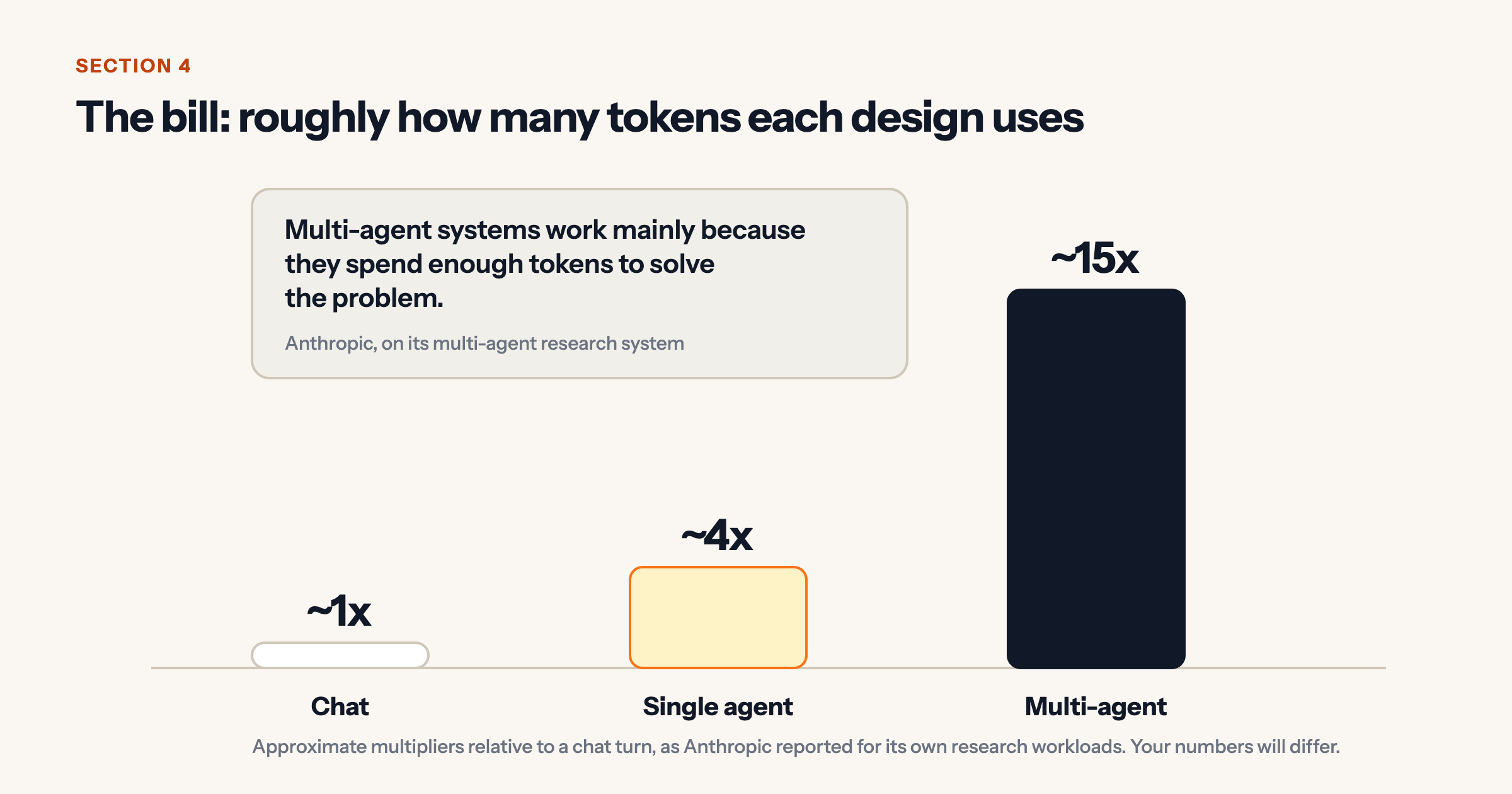
Multi-agent systems work mainly because they spend enough tokens to solve the problem. That is fine when the task is valuable and splits cleanly. It is waste when it does not.
5. Should this task be multi-agent?
Ask three questions.
- Can the work split into independent parts? If not, use a single agent with tools, or a workflow.
- Does the value justify roughly fifteen times the tokens? If not, stay with a single agent and measure first.
- Do the parts need shared context or each other’s results? If yes, keep it single.
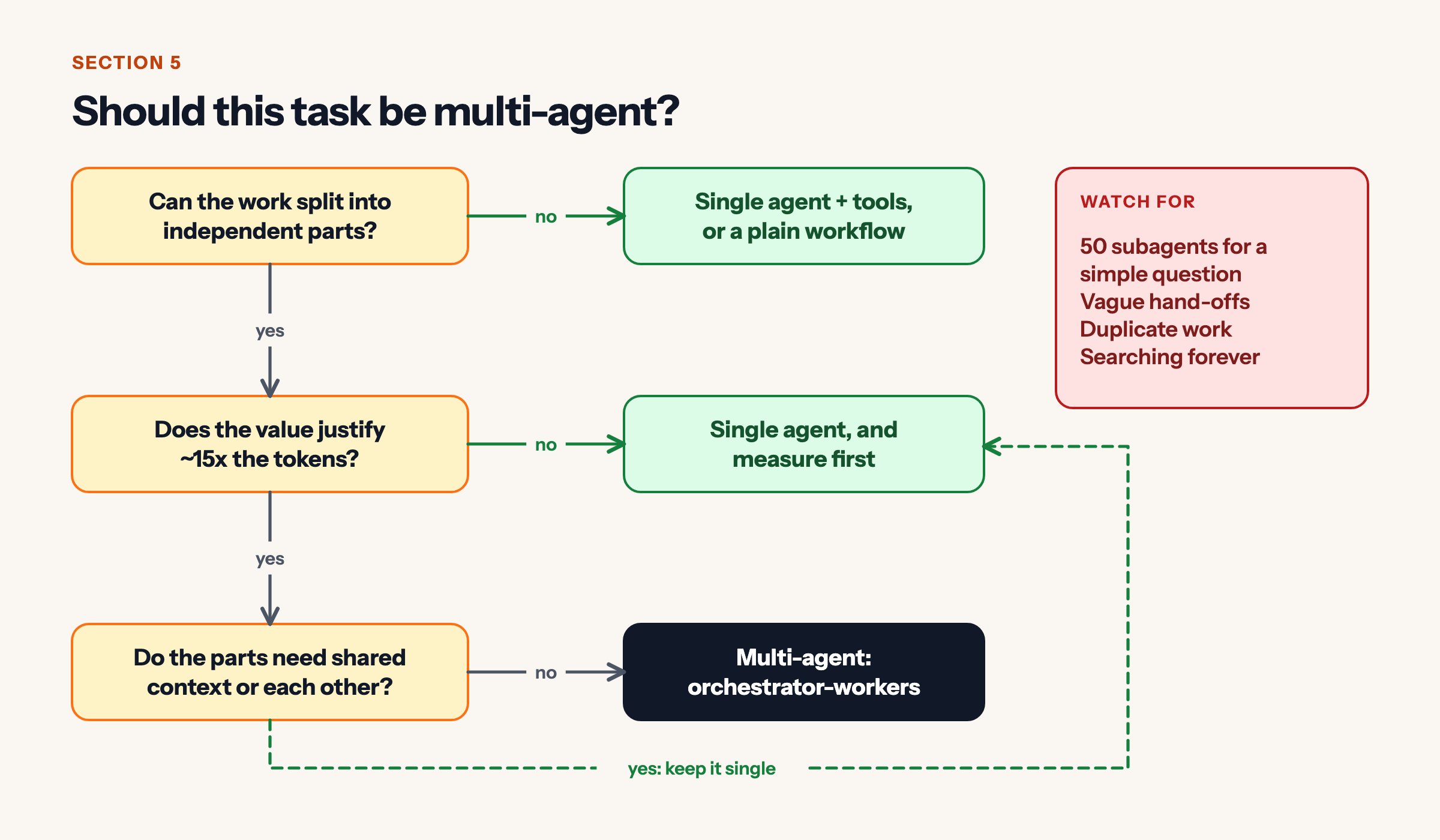
Common failure modes: spawning dozens of subagents for a simple question, vague hand-offs, duplicated work and searching forever.
6. Evaluate it like a product, not a demo
Start with about twenty real queries. Run the system and trace every step. Score the results with an LLM judge using one rubric, then have a person spot-check what the judge misses. Fix prompts, tool descriptions and delegation, then rerun.
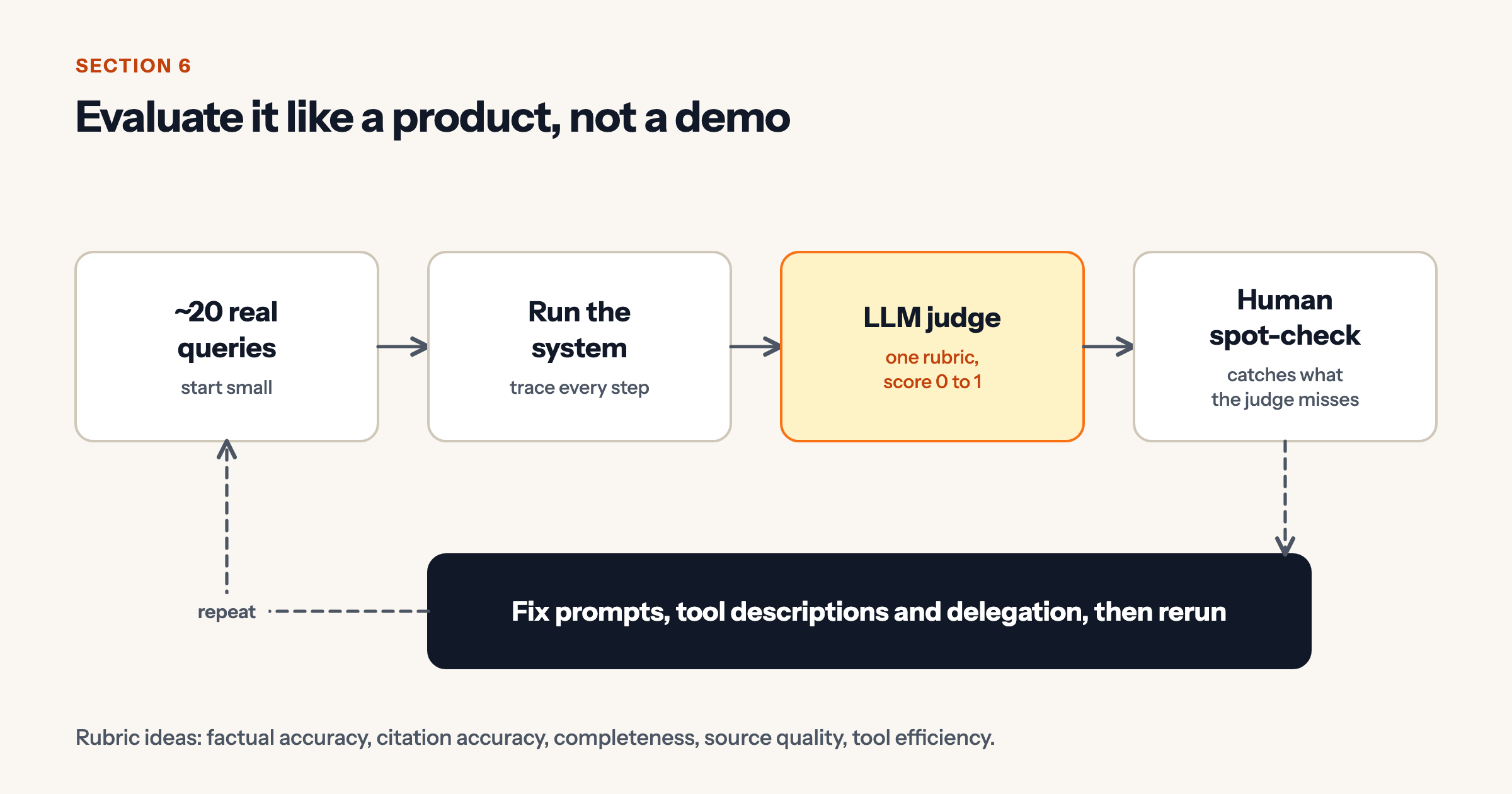
Useful rubric items: factual accuracy, citation accuracy, completeness, source quality and tool efficiency.
Takeaways
- Prefer workflows. Reach for agents when the path cannot be written down.
- Multi-agent is one pattern, not a goal. It costs about an order of magnitude more tokens.
- Delegate with precise tasks and condensed returns.
- Measure with real queries before you scale.
Sources
- Anthropic, “Building effective agents”.
- Anthropic Engineering, “How we built our multi-agent research system”.


